Montessori Currirulum
Our Learning Journey: The Great Lessons & Beyond
Inspired by Dr Maria Montessori's Cosmic Education, our curriculum is guided by the five Great Lessons. Story-based introductions that spark exploration across subjects. These stories are told throughout the year:
TERM 1
The Universe Story → Science
Coming of Life → Botany & Zoology
TERM 2
Coming of Humans → History & Culture
Story of Language & Numbers → English & Maths
TERM 3
Story of the Human Body → Health Science
Children engage in:
English: spelling, grammar, creative writing, reading, and phonics
Mathematics: number sense, operations, geometry, fractions, and measurement
Science, Geography, History, Zoology, Botany, and more.
Children plan their own learning projects in collaboration with guides.
Each day, children record one of each of the following in their journals based on their individual planning: maths, English, spelling, reading, and project work. They plan their own learning in collaboration with guides, attend weekly check-ins, and keep age-appropriate journals to track progress.
Term 1
Term 2
Term 3
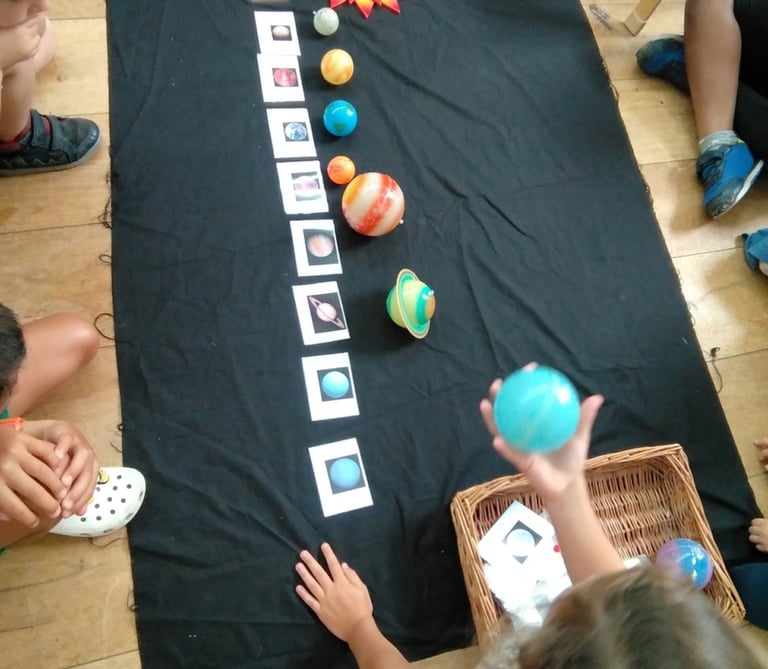
Term 1 opens with the Universe Story, inviting children to explore how our cosmos began, how stars and planets formed, and what makes Earth unique. Through demonstrations, simple experiments, and observation, children investigate states of matter, gravity, light, and heat, and begin to understand scientific inquiry and record keeping. We emphasise curiosity, precise language, and careful use of scientific equipment, building the habits needed for independent study.
The Coming of Life extends the narrative to Earth’s timeline, introducing major eras, mass extinctions, and the emergence of life. Children study classification, plant and animal needs, and interdependence in ecosystems. Practical botany and zoology include seed dissections, leaf surveys, micro-habitat studies, and observational drawing. By the end of term, each child contributes to a class timeline and a field guide of local species, linking global concepts to our immediate environment.
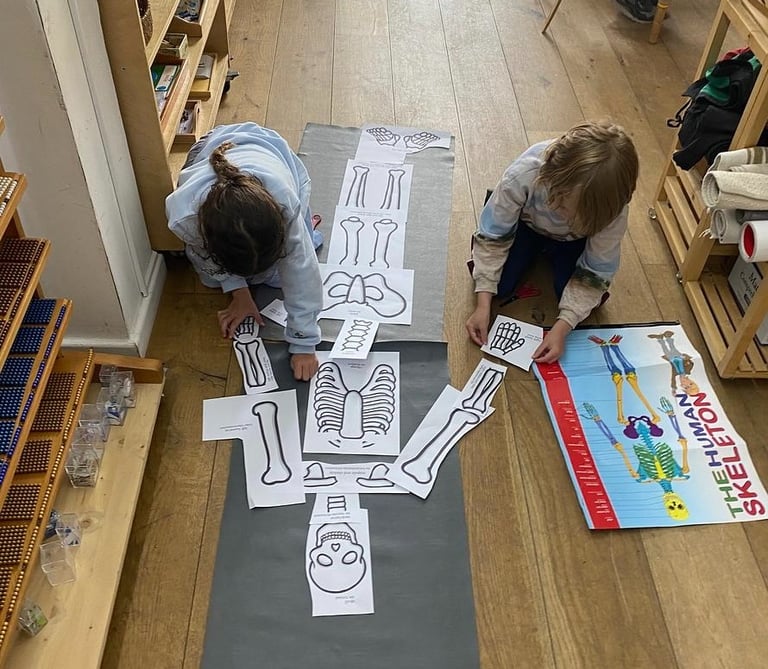
Term 3 turns inward to the Story of the Human Body, building a respectful understanding of how we grow, move, think, and stay well. Children study major systems such as skeletal, muscular, circulatory, respiratory, and digestive with age-appropriate models, diagrams, and investigations like pulse checks, breathing rates, and food energy experiments. We link structure to function and highlight how systems work together.
Health science threads throughout daily routines. Children consider sleep, hydration, nutrition, movement, and emotional regulation, learning practical strategies for self-care and community wellbeing. The term culminates in each child curating a “Body and Wellbeing” showcase page that combines labelled diagrams, short explanations, and reflections on healthy habits, demonstrating both subject knowledge and personal responsibility.
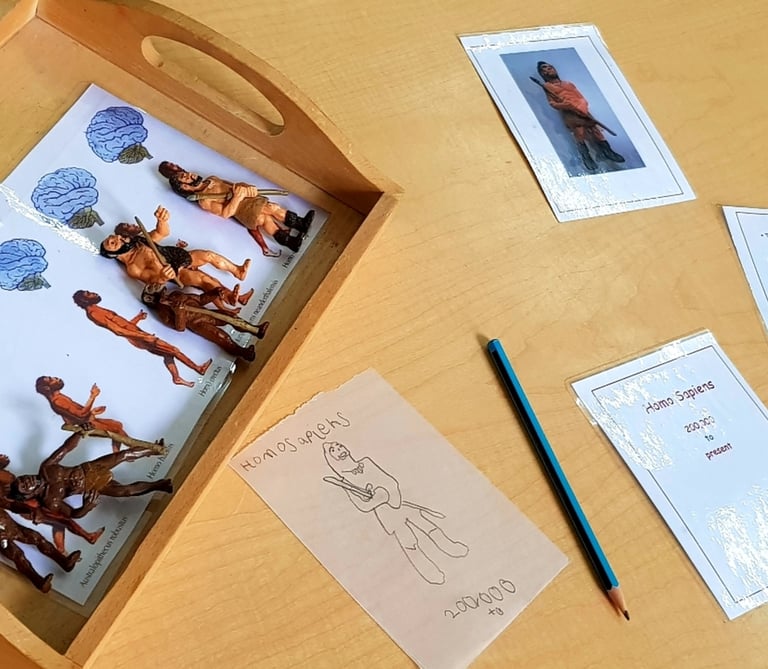
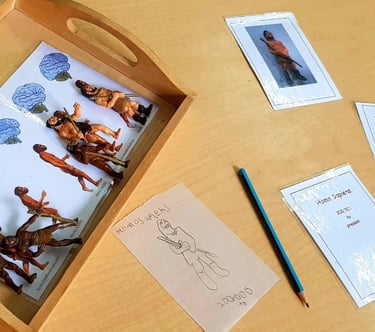
Term 2 focuses on the Coming of Humans, tracing how early peoples adapted to their environments, developed tools, art, and community, and formed cultures. Children examine timelines, artefacts, and case studies from different regions, comparing shelter, clothing, food, and belief systems. They practise historical thinking by asking questions, weighing evidence, and presenting findings clearly. Respect for cultural diversity and careful sourcing are central.
The Story of Language and Numbers shows how writing systems and mathematics evolved to solve human problems. In English, children explore the journey from pictograms to alphabets, practise word study, sentence construction, and short compositions linked to their history projects. In Maths, they deepen number sense, place value, and operations, and meet early measurement, geometry, and data handling. Activities connect reading, writing, and calculation to practical tasks such as trade simulations, map scales, and coded messages, reinforcing the purpose behind literacy and numeracy.
Play, Movement, & Nature
Alongside the Montessori workcycle, our days are shaped by the rhythms children need to truly flourish. Regular breaks, free-flow play, group games, and physical activity are woven throughout each day - not as extras, but as learning in their own right. Our outdoor space extends beyond our generous grounds into the wild green spaces of south-east London, One Tree Hill is just next door. Each term we also venture further afield on a group trip, bringing our community together beyond the classroom and broadening children's experience of the world around them.

